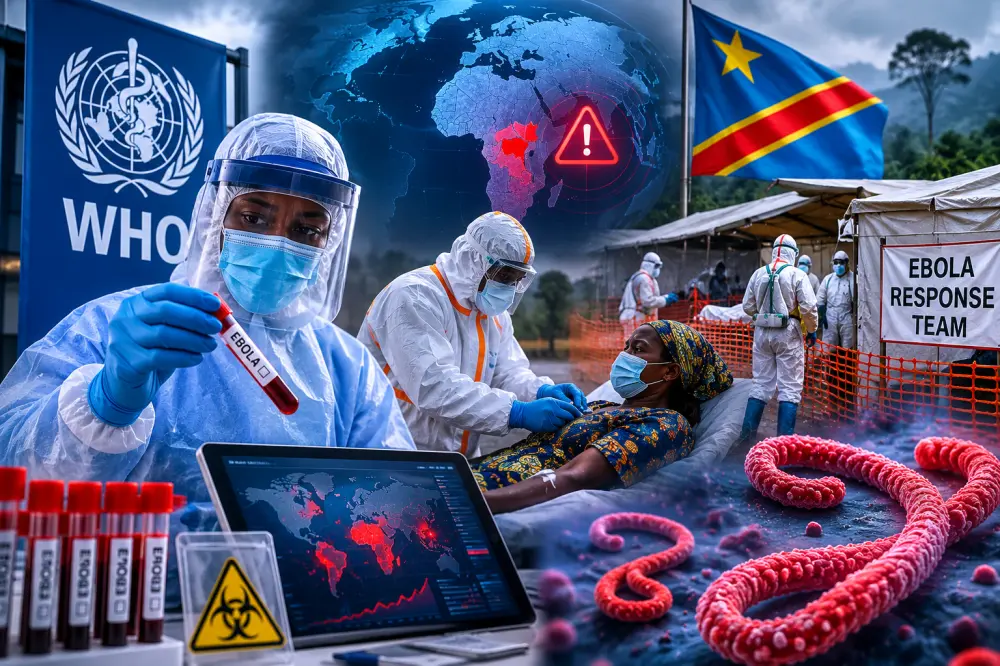
The World Health Organization (WHO) has issued an urgent warning after confirming that the Democratic Republic of Congo is experiencing what health officials describe as the country's fastest-growing Ebola outbreak in recent years. The rapid spread of infections has prompted emergency containment measures as international medical teams work to prevent the virus from reaching densely populated urban areas.
Health authorities say the outbreak has expanded more quickly than initially expected, with new cases being identified across multiple communities. Contact tracing teams, mobile laboratories, and emergency response units have been deployed in an effort to isolate infections and break transmission chains before they spread further.
Ebola is one of the world's deadliest viral diseases, causing severe fever, internal bleeding, and multiple organ failure in many patients. While modern treatments and vaccines have significantly improved survival rates compared with earlier outbreaks, rapid detection remains essential because the virus spreads through direct contact with infected bodily fluids.
The Democratic Republic of Congo has faced multiple Ebola outbreaks over the past two decades, giving health authorities valuable experience in responding to the disease. However, officials warn that population movement, limited healthcare infrastructure in remote areas, and public misinformation continue to complicate containment efforts.
The WHO is working alongside the Congolese government, international aid agencies, and neighboring countries to strengthen border surveillance, expand laboratory testing, and accelerate vaccination campaigns for people identified as high-risk contacts. Medical supplies and additional healthcare workers are also being deployed to affected regions.
Global health experts stress that the current situation does not represent a worldwide pandemic but requires close international monitoring. Previous Ebola outbreaks have demonstrated that rapid intervention, public education, and coordinated healthcare responses are essential to preventing wider regional transmission.
Governments in neighboring countries have increased health screening at border crossings while hospitals have been advised to strengthen preparedness plans in case suspected infections are detected. International airports are also monitoring travelers arriving from affected regions in accordance with existing public health protocols.
The outbreak highlights the continuing importance of global disease surveillance. Health organizations note that early reporting, rapid laboratory confirmation, and transparent international cooperation remain among the most effective tools for controlling infectious disease emergencies.
Scientists continue researching improved Ebola vaccines, antiviral treatments, and diagnostic technologies. Recent medical advances have dramatically improved survival rates, offering hope that outbreaks can be controlled more effectively than in previous decades.
As emergency teams continue working across affected communities, the WHO has urged governments, healthcare organizations, and international partners to support Congo's response efforts. Officials say rapid containment during the coming weeks will be critical in preventing the outbreak from expanding further and protecting vulnerable populations.


 Cristiano Ronaldo has hinted that the 2026–27 season could be his final year in professional football after more than two decades at the top of the sport.


0 Comments: