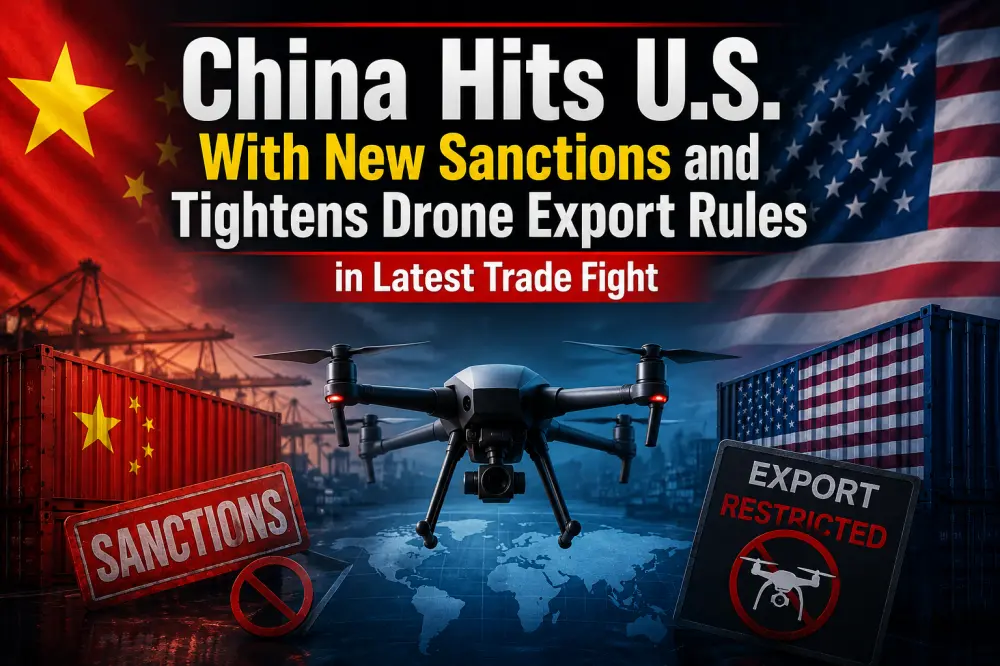
China has announced new sanctions against several American companies and tightened controls on the export of drones and related technologies to the United States, opening another front in the increasingly complicated economic and technology rivalry between Beijing and Washington.
The measures announced by China's Ministry of Commerce target six U.S. companies and come as both governments continue negotiating over trade, technology restrictions and national security concerns.
The latest move adds to a growing list of restrictions imposed by the world's two largest economies on each other's companies and technologies. While Washington has increasingly limited China's access to advanced technology and expanded restrictions on Chinese products, Beijing has responded with its own export controls, sanctions and measures designed to protect industries considered strategically important to China's national interests.
China's new drone restrictions are particularly significant because Chinese manufacturers dominate much of the global commercial drone market. Companies based in China have built major positions in consumer, industrial, agricultural and professional drone applications, making Beijing's decision to introduce tighter export oversight potentially important for American businesses and consumers.
Under the new rules, certain drone exports and transfers of sensitive drone technologies to the United States will face greater scrutiny. Instead of allowing unrestricted transfers, Chinese authorities can review individual transactions and determine whether specific products, components or technologies should receive approval.
The measures do not amount to a blanket ban on every Chinese drone entering the United States, but they represent a significant tightening of oversight. Sensitive technologies with potential military or strategic applications are expected to receive particular attention, reflecting growing concerns in both Beijing and Washington about the dual-use nature of modern drones.
Drones have become much more than consumer gadgets in recent years. Modern unmanned aircraft can carry advanced cameras, thermal sensors, navigation systems, artificial intelligence software and communications equipment, making them useful for agriculture, construction, mapping, logistics, surveillance and military operations.
That dual-use capability has made drones a major part of the technology competition between China and the United States. Governments increasingly view advanced drone systems as strategic technologies because the same components used for commercial applications can potentially be adapted for military purposes.
Washington has already taken steps to restrict certain foreign-made drones and technologies because of national security concerns. U.S. officials have argued that some advanced unmanned systems could create security risks if sensitive data or technological capabilities are transferred to foreign governments.
Beijing has criticized American restrictions on Chinese technology, arguing that Washington is using national security arguments to limit Chinese companies and protect American industries from competition. Chinese officials have repeatedly called for fair international trade while warning that excessive restrictions could damage global supply chains.
The latest sanctions therefore come at a sensitive time for the global economy.
Businesses have spent years building supply chains that depend on Chinese manufacturing, while American companies remain major suppliers of software, semiconductors, financial services and advanced technologies. Increasing restrictions on both sides are forcing companies to reconsider where products are manufactured, where components are sourced and which markets they can enter.
The drone industry is particularly exposed because many manufacturers depend on internationally connected supply chains. Components such as motors, batteries, cameras, sensors, navigation systems and electronic controllers can come from different countries before being assembled into finished products.
New export restrictions could therefore increase costs for American companies that rely on Chinese suppliers. Businesses may need to find alternative sources, negotiate new contracts or invest in domestic manufacturing capacity.
For consumers, the effects could eventually appear through higher prices and fewer product choices. Professional users who depend on drones for surveying, photography, agriculture and industrial inspections could also face longer delivery times if manufacturers encounter difficulties obtaining Chinese components.
The geopolitical significance may be even greater than the immediate economic impact.
Drones are becoming an increasingly important part of modern warfare, particularly in conflicts where relatively inexpensive unmanned aircraft can be used for surveillance, targeting and attacks.
The experience of recent wars has demonstrated how rapidly drone technology can evolve when manufacturers receive feedback from battlefield conditions.
That has made governments more interested in controlling the international movement of advanced drone technologies.
China's position in the global drone industry gives Beijing considerable influence over the supply chain. Tightening exports could therefore become an important tool in broader negotiations with Washington.
The timing of the announcement is also significant because President Donald Trump and Chinese President Xi Jinping are expected to continue discussions over trade and economic relations. Both governments have an interest in preventing their disagreements from developing into a full-scale economic confrontation, but neither side appears willing to abandon policies designed to protect strategic industries.
The two countries remain deeply connected economically despite their rivalry. American companies continue doing business in China, while Chinese manufacturers depend heavily on access to American consumers and international markets.
That interdependence makes the current dispute complicated. Restrictions can hurt the targeted country, but they can also create costs for the government imposing them.
The technology sector is one of the clearest examples.
The United States has tightened controls on advanced semiconductors and artificial intelligence-related equipment, while China has increasingly focused on strengthening its domestic technology industry and reducing dependence on American suppliers.
The drone industry is now becoming another battlefield in that larger technology competition.
Artificial intelligence is also playing a growing role in drone development. Modern drones can use AI to recognize objects, navigate complex environments, analyze images and operate with increasing levels of autonomy. That makes advanced drone systems increasingly relevant to both civilian industries and national security.
As AI capabilities improve, governments are likely to pay even greater attention to the export of autonomous systems and related components.
The latest Chinese measures therefore could become part of a much larger global debate about who controls critical technologies and how governments should regulate products that have both civilian and military applications.
Other countries are watching the dispute closely. European governments, Asian economies and emerging markets depend on Chinese manufacturing while also maintaining close economic and security relationships with the United States.
A prolonged technology conflict between Washington and Beijing could force other countries to make difficult decisions about which technology standards, suppliers and supply chains they want to rely on.
For companies, diversification is becoming increasingly important. Businesses that previously depended on a single country for manufacturing or components are now exploring suppliers in Southeast Asia, India, Mexico and other regions.
That shift could gradually reshape global manufacturing.
However, replacing China's industrial capacity will not happen quickly. China has spent decades building large-scale manufacturing networks, specialized suppliers, ports, logistics infrastructure and skilled industrial workforces. Creating alternative supply chains requires enormous investment and time.
The drone sector illustrates that challenge particularly well.
Even if American companies increase domestic drone production, they may still depend on foreign suppliers for specialized components. Reducing dependence on China could therefore require an entire ecosystem of new manufacturers rather than simply building more assembly plants.
Investors are also watching the dispute because further restrictions could create winners and losers across the technology industry. American manufacturers capable of replacing Chinese suppliers could benefit, while companies heavily dependent on Chinese components could face higher costs.
The broader economic consequences will depend on how far the confrontation goes.
If Washington and Beijing keep the restrictions narrowly focused on sensitive technologies, the economic damage could remain manageable. If the dispute expands into wider restrictions on consumer electronics, industrial equipment, batteries, vehicles and other products, the consequences could become much larger.
For now, the latest measures signal that the technology rivalry between China and the United States is far from over.
Drones have emerged as one of the newest strategic battlegrounds because they combine commercial value with military importance. China's dominance of the industry gives Beijing leverage, while America's growing restrictions on Chinese technology give Washington its own powerful tools.
The coming months could therefore bring more export controls, sanctions and investment restrictions from both sides.
For businesses and consumers, the biggest question is how quickly the two countries can stabilize their relationship before technology restrictions begin creating deeper disruptions across global supply chains.
For the global technology industry, the message from Beijing's latest decision is clear: drones are no longer simply consumer electronics. They have become strategic technology, and the competition over who controls their production, software and international distribution is becoming another major chapter in the wider economic rivalry between China and the United States.


 Cristiano Ronaldo has hinted that the 2026–27 season could be his final year in professional football after more than two decades at the top of the sport.



0 Comments: