NASA is accelerating work on a new generation of planetary defense technology designed to detect potentially hazardous asteroids much earlier than existing systems, giving scientists more time to evaluate possible risks and, if necessary, prepare strategies to protect Earth. The project represents another major step in the international effort to improve humanity's ability to monitor objects traveling through the solar system that could one day threaten the planet.
Every day, thousands of rocky objects pass through Earth's cosmic neighborhood. Most are small enough to burn up harmlessly in the atmosphere, but larger asteroids remain a focus for astronomers because even a single impact from a sufficiently large object could cause devastating regional or global consequences. Although experts emphasize that no known asteroid currently poses an immediate threat to Earth, continuous monitoring remains essential because new objects are discovered every year.
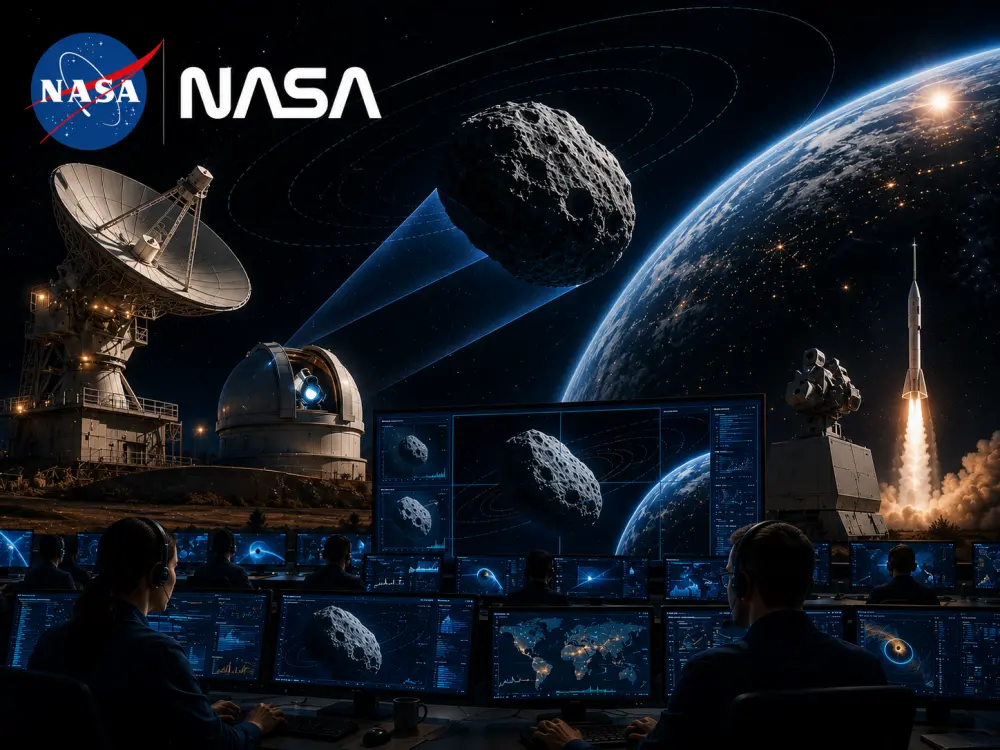
The latest planetary defense initiative combines powerful ground-based observatories, space telescopes, advanced computer simulations, and artificial intelligence capable of analyzing enormous amounts of astronomical data. Instead of relying solely on human observation, the AI system rapidly identifies unusual movement patterns, calculates orbital paths, and flags objects that deserve closer investigation. This dramatically reduces the time required to classify newly discovered asteroids while improving the accuracy of long-term predictions.
One of the biggest challenges in asteroid detection is that many objects approach Earth from directions that are difficult for traditional telescopes to observe, particularly those traveling from the direction of the Sun. To solve this problem, NASA and its international partners are investing in new space-based observatories positioned beyond Earth's atmosphere, allowing astronomers to detect dim objects that might otherwise remain hidden until they are much closer.
The project builds on valuable lessons learned from NASA's historic Double Asteroid Redirection Test (DART), which successfully demonstrated that a spacecraft could intentionally alter the orbit of an asteroid by colliding with it at high speed. That mission proved that humanity has at least one practical method of changing the trajectory of certain space objects if sufficient warning time exists.
Scientists say early detection is the most important factor in planetary defense. If a potentially hazardous asteroid is identified decades before a possible encounter with Earth, relatively small changes to its orbit could prevent any future collision. Waiting until the object is only months away would dramatically reduce the available options and increase the complexity of any response mission.
International cooperation plays a central role in the program. Space agencies, universities, and research organizations across Europe, Asia, and the Americas regularly exchange astronomical observations and orbital calculations through global monitoring networks. This collaboration allows researchers to verify discoveries, improve tracking accuracy, and maintain a continuously updated catalogue of near-Earth objects.
Beyond protecting Earth, asteroid research is providing valuable scientific knowledge about the origins of the solar system. Many asteroids are considered time capsules that have remained largely unchanged for billions of years. Studying their composition helps scientists better understand how planets formed and how water and organic materials may have been delivered to Earth during the early history of the solar system.
The technology being developed for planetary defense also has wider applications. Artificial intelligence designed to identify faint moving objects in space is improving image processing, data analysis, and automated detection systems used in other areas of scientific research. Advances in telescope engineering, autonomous spacecraft navigation, and precision tracking are expected to benefit future missions exploring the Moon, Mars, and the outer planets.
Although asteroid impacts remain extremely rare, experts argue that preparation is far less costly than responding to an unexpected disaster. History has shown that even relatively small space rocks can cause significant local damage, while larger impacts have shaped Earth's geological and biological history. Modern monitoring systems are designed to ensure that humanity is never caught by surprise.
As NASA continues expanding its planetary defense capabilities, the agency hopes the combination of advanced telescopes, artificial intelligence, and international scientific cooperation will provide the earliest possible warning of any future asteroid threat. The ongoing investment demonstrates how space exploration is increasingly focused not only on discovering the universe but also on protecting the planet we call home.

 Cristiano Ronaldo has hinted that the 2026–27 season could be his final year in professional football after more than two decades at the top of the sport.




0 Comments: