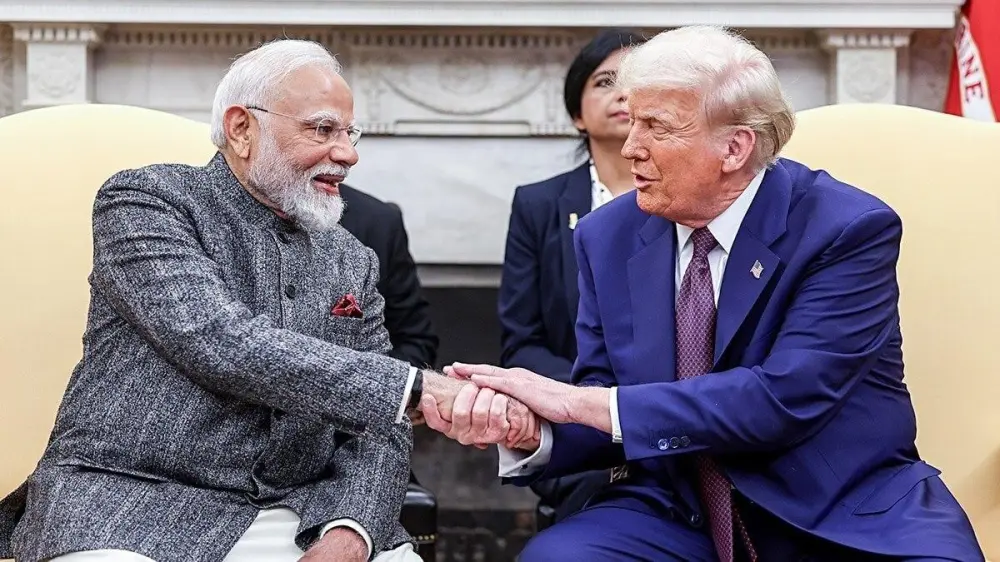
President Donald Trump and Indian Prime Minister Narendra Modi have renewed efforts to strengthen economic ties between the United States and India, signaling that negotiations toward a new bilateral trade agreement remain a priority for both governments. The discussions took place during high-level diplomatic meetings where trade, investment, technology cooperation, and market access dominated the agenda.
The renewed dialogue comes at a time when both countries are seeking to deepen one of the fastest-growing strategic partnerships in the world. The United States remains one of India's largest trading partners, while India continues to expand its role as a major global manufacturing and technology hub. Officials from both sides believe a broader trade agreement could unlock billions of dollars in additional investment and create new opportunities for businesses operating across multiple industries.
Speaking after the meeting, Trump described the discussions with Modi as productive and expressed confidence that both countries could reach what he called a "very good deal." Although negotiators acknowledged that no final agreement has yet been reached, both governments indicated that technical discussions will continue in the coming weeks as they work through outstanding issues involving tariffs, agricultural exports, digital commerce, and industrial market access.
Trade negotiations between Washington and New Delhi have continued for several years, with both sides seeking greater access to each other's markets while protecting key domestic industries. The United States has pushed for improved access for agricultural products, medical devices, financial services, and digital businesses, while India has sought lower tariffs on exports including textiles, pharmaceuticals, engineering products, and information technology services.
Technology cooperation has also become an increasingly important pillar of the relationship. Artificial intelligence, semiconductor manufacturing, cloud computing, defense technology, and critical minerals are expected to play central roles in future economic cooperation. Both governments view these sectors as strategically important for strengthening supply chains and reducing dependence on rival manufacturing centers.
Business leaders are closely monitoring the negotiations because a successful agreement could increase trade volumes, encourage foreign direct investment, and improve business confidence. Companies operating in manufacturing, technology, pharmaceuticals, automotive production, and renewable energy could benefit from reduced trade barriers and improved regulatory cooperation.
The global significance of the negotiations extends beyond the two countries themselves. Together, the United States and India represent two of the world's largest economies, and closer economic integration could influence international supply chains, investment flows, and regional trade dynamics across Asia and North America.
Economists note that global businesses are increasingly diversifying manufacturing operations as companies seek more resilient supply chains following recent geopolitical disruptions. India has emerged as one of the primary beneficiaries of this trend, attracting multinational corporations looking to expand production outside traditional manufacturing centers.
Despite the positive tone, negotiators still face complex issues before a comprehensive agreement can be finalized. Market access, tariff reductions, intellectual property protections, digital taxation, and regulatory standards remain among the subjects requiring further discussion. Trade experts believe both governments are committed to reaching common ground but caution that negotiations involving large economies often require considerable time.
For investors and global markets, continued progress in U.S.-India trade relations would be viewed as a positive signal for international commerce. A stronger economic partnership between Washington and New Delhi has the potential to boost bilateral trade, encourage business expansion, and reinforce cooperation in emerging industries that are expected to shape the global economy over the coming decade.


 Cristiano Ronaldo has hinted that the 2026–27 season could be his final year in professional football after more than two decades at the top of the sport.


0 Comments: