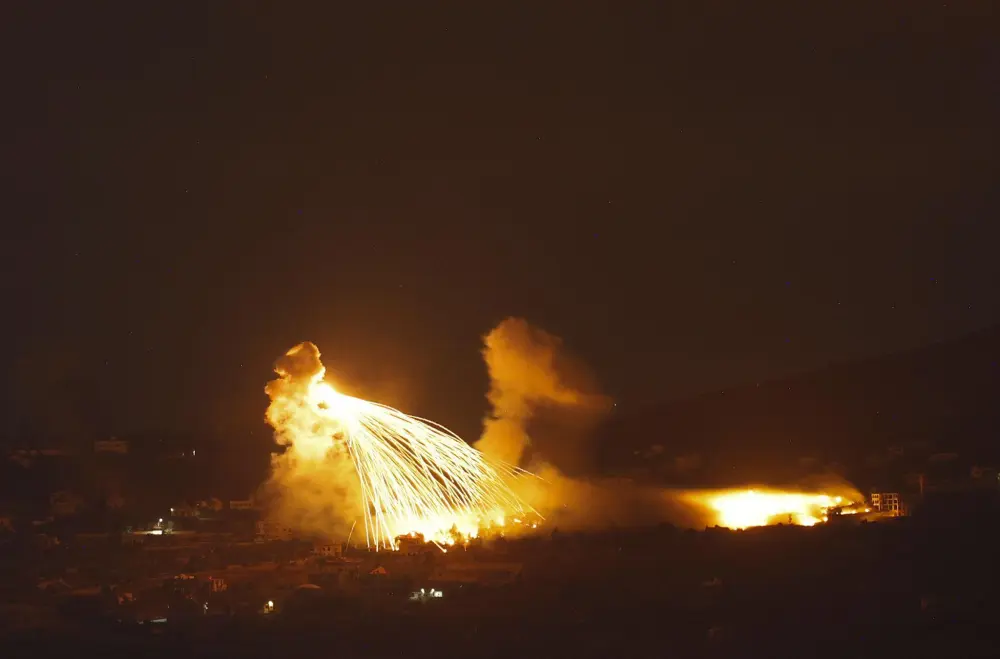
Fighting along the Israel-Lebanon border has escalated once again after renewed exchanges of fire between Israeli forces and Hezbollah fighters in southern Lebanon, underscoring how fragile recent ceasefire efforts remain despite repeated diplomatic attempts to stabilize the region.
Security officials and local reports indicate that artillery fire, drone activity, and targeted strikes were recorded across multiple border points, marking one of the most serious flare-ups in recent weeks. The developments come at a time when international mediators have been pushing for restraint and attempting to prevent the conflict from expanding into a broader regional war.
The renewed violence highlights a long-standing pattern in the Israel-Lebanon conflict, where temporary pauses in fighting are frequently followed by sudden escalations driven by local incidents, retaliatory strikes, or wider regional tensions linked to other Middle East conflicts.
Border Region Remains One of the Most Volatile Frontlines
The southern Lebanon border has remained a persistent flashpoint for decades, shaped by unresolved political disputes, historical military confrontations, and the continued presence of armed groups operating in the area.
Even during periods of relative calm, both Israel and Hezbollah maintain high levels of military readiness along the frontier. Surveillance operations, air patrols, and fortified defensive positions remain active on both sides, reflecting deep mistrust and the absence of a long-term security agreement.
Analysts note that the region has effectively become a “pressure zone” where any small-scale incident can rapidly escalate into wider exchanges of fire, particularly when linked to broader geopolitical developments in the Middle East.
Hezbollah’s Strategic Position in the Conflict
Hezbollah continues to play a central role in shaping security dynamics along the border. The group, which maintains significant political and military influence in southern Lebanon, has repeatedly stated that its operations are tied not only to Lebanon’s security concerns but also to wider regional conflicts.
Israeli officials, however, view Hezbollah as a major security threat, citing its arsenal of rockets, drones, and cross-border operational capabilities. This perception has driven repeated Israeli strikes in response to what it describes as hostile activity originating from Lebanese territory.
The result is a cycle of action and retaliation that has proven difficult to break, even during periods when diplomatic efforts temporarily reduce the intensity of the conflict.
Civilian Communities Caught in the Middle
The latest escalation has once again raised concerns over the impact on civilians living in border communities on both sides.
In southern Lebanon, residents have reported displacement, infrastructure damage, and ongoing uncertainty as clashes continue to disrupt daily life. Many families in the region have already endured repeated waves of instability linked to previous conflicts and economic hardship.
On the Israeli side, communities near the northern border have also been affected by security alerts, restricted movement, and precautionary shelter measures during periods of heightened tension.
Humanitarian groups continue to warn that prolonged instability could deepen existing social and economic pressures in already vulnerable areas.
Diplomatic Efforts Struggle to Contain Escalation
International actors have repeatedly called for restraint, urging both Israel and Hezbollah to avoid actions that could trigger a wider conflict.
Diplomatic discussions have focused on reinforcing ceasefire arrangements and establishing clearer mechanisms to prevent misunderstandings along the border. However, progress has been limited due to deep political divisions and the absence of direct communication channels between the two sides.
Observers say that while ceasefire efforts can temporarily reduce violence, they do not address the underlying strategic tensions that continue to drive periodic escalations.
Risk of Wider Regional Spillover
The situation along the Israel-Lebanon border remains closely linked to broader developments in the Middle East, where multiple conflicts continue to interact and influence each other.
Security analysts warn that continued escalation could draw in additional regional actors, further complicating an already unstable security environment.
For now, the situation remains fluid, with both sides maintaining military readiness while international mediators continue efforts to prevent further deterioration.


 Cristiano Ronaldo has hinted that the 2026–27 season could be his final year in professional football after more than two decades at the top of the sport.

0 Comments: