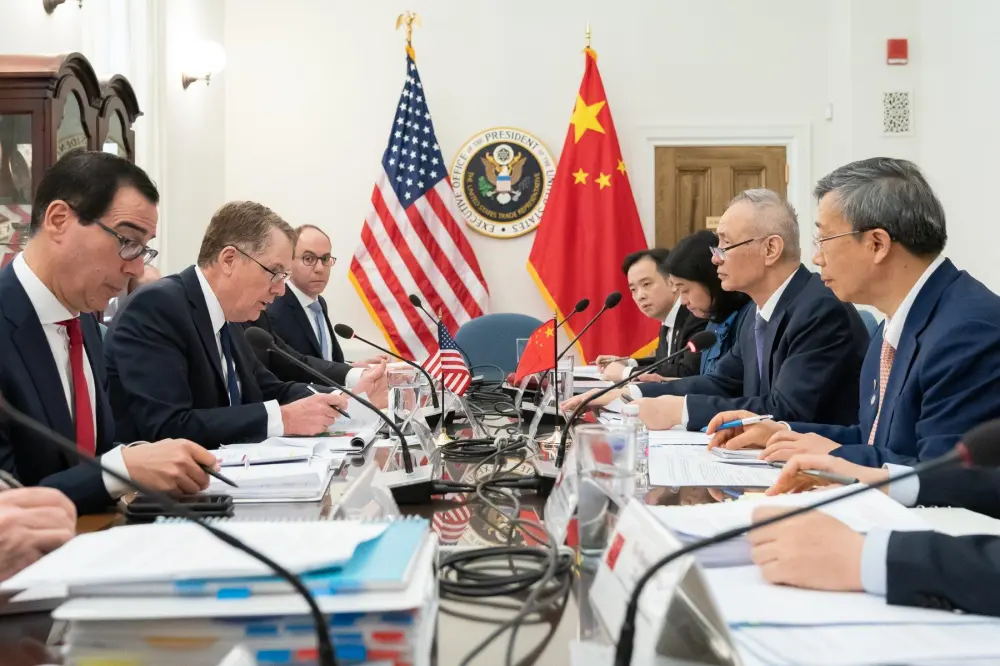
China has renewed its call for the United States to remove existing tariffs on Chinese goods as both countries continue negotiations aimed at improving trade relations and reducing economic uncertainty. The latest round of discussions comes at an important time for the global economy, with businesses, investors, and manufacturers closely monitoring whether the world's two largest economies can reach agreements that restore confidence in international trade.
Chinese officials argue that removing tariffs would benefit businesses and consumers in both countries by lowering import costs, improving market access, and encouraging greater cross-border investment. They maintain that reducing trade barriers would help strengthen global economic growth at a time when many economies continue to face slower expansion, rising production costs, and uncertainty surrounding international demand.
Trade relations between Washington and Beijing have remained one of the defining issues in the global economy over the past several years. Tariffs introduced during earlier disputes affected hundreds of billions of dollars worth of goods, increasing costs for manufacturers, retailers, and consumers while forcing companies to rethink supply chains and sourcing strategies.
Although both governments have made progress through several rounds of negotiations, many tariffs remain in place across key industries including technology, manufacturing, agriculture, automotive products, and industrial equipment. Business groups on both sides have repeatedly called for greater certainty, arguing that long-term investment decisions become more difficult when trade policies remain unpredictable.
Manufacturing companies are among those most affected by the ongoing tariffs. Many businesses depend on international supply chains that stretch across multiple countries, meaning higher import duties often increase production costs throughout the manufacturing process. Some companies have responded by relocating production facilities, while others have diversified suppliers to reduce exposure to future trade disputes.
Financial markets are also paying close attention to the negotiations. Investors generally view improved U.S.-China relations as a positive signal for global economic stability because stronger trade between the two countries supports international commerce, commodity demand, and business investment. Positive developments often boost stock markets, while renewed tensions can trigger volatility across global financial markets.
Technology remains another major area of discussion. Both governments continue to negotiate issues involving semiconductor exports, artificial intelligence, advanced manufacturing, and digital trade. These sectors have become increasingly important as countries compete for leadership in next-generation technologies that are expected to drive future economic growth.
Agricultural exports also remain central to the negotiations. China is one of the world's largest importers of agricultural products, while American farmers continue seeking expanded access to Chinese markets. Any agreement involving lower tariffs could increase exports of grains, meat, and other agricultural commodities while helping stabilize global food supply chains.
Economists believe the outcome of the talks could influence inflation in several major economies. Lower tariffs would reduce import costs for many products, potentially easing price pressures for businesses and consumers. At the same time, stronger trade flows could support manufacturing activity and encourage additional private-sector investment.
Despite continued dialogue, significant differences remain on several issues including industrial subsidies, intellectual property protection, technology transfer, and market access. Negotiators from both countries acknowledge that reaching a comprehensive agreement will require further discussions, but officials continue to express optimism that practical solutions remain possible.
For businesses around the world, the negotiations represent more than a bilateral trade issue. The relationship between the United States and China influences global investment, manufacturing, shipping, commodity prices, and financial markets. As discussions continue, investors and policymakers will be watching closely for any breakthrough that could reshape the outlook for international trade and the global economy.


 Cristiano Ronaldo has hinted that the 2026–27 season could be his final year in professional football after more than two decades at the top of the sport.




0 Comments: