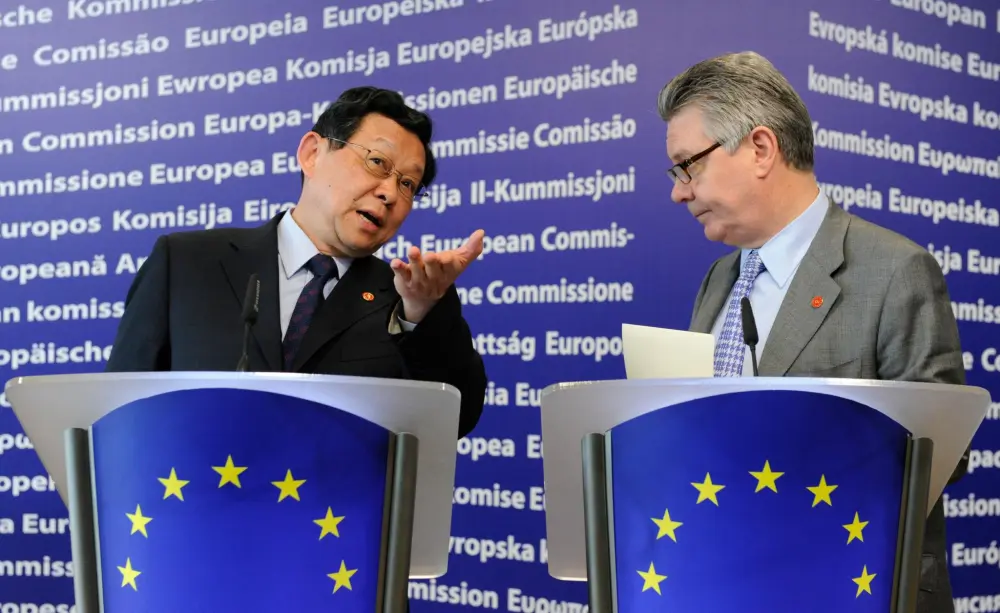
China and the European Union have opened a new round of high-level trade negotiations in an effort to prevent a fresh tariff dispute that could disrupt billions of dollars in international commerce. Officials from both sides are meeting ahead of an important global summit, hoping to resolve disagreements over electric vehicles, industrial subsidies, technology exports, and market access before tensions escalate further.
The latest discussions come at a critical time for the global economy. Businesses around the world are already facing higher borrowing costs, slowing economic growth, and continuing geopolitical uncertainty. A new trade conflict between two of the world's largest economies could increase costs for manufacturers, disrupt supply chains, and place additional pressure on global markets.
One of the biggest issues under discussion is the European Union's investigation into Chinese-made electric vehicles. European officials argue that generous government support has allowed Chinese manufacturers to sell electric cars at prices that make competition difficult for European automakers. China has rejected the accusations, insisting its electric vehicle industry has grown through innovation, investment, and technological development rather than unfair subsidies.
Trade experts say the dispute extends far beyond the automotive industry. Negotiators are also discussing renewable energy equipment, advanced manufacturing technologies, semiconductor cooperation, agricultural exports, and digital trade rules. These sectors have become increasingly important as governments invest heavily in clean energy, artificial intelligence, and advanced industrial production.
Chinese officials have warned that additional European tariffs could trigger retaliatory measures against European exports entering the Chinese market. European leaders, meanwhile, continue to insist they are seeking fair competition rather than restricting international trade. Both sides have emphasized that dialogue remains the preferred solution, but businesses are preparing for the possibility that negotiations may not produce an immediate breakthrough.
The economic relationship between China and the European Union is among the largest in the world. Every year, hundreds of billions of dollars' worth of goods move between Chinese factories and European consumers. Electronics, automobiles, industrial machinery, pharmaceuticals, renewable energy equipment, luxury products, and agricultural goods are all heavily dependent on stable trade between the two markets.
Financial markets are monitoring the negotiations closely because any escalation could affect stock markets, commodity prices, shipping companies, and manufacturing businesses across Asia and Europe. Investors are particularly interested in whether both sides can avoid another round of tariffs similar to previous trade disputes that slowed international commerce and increased costs for businesses worldwide.
Economists note that the outcome of these talks will likely influence global trade policy for years to come. Many countries are carefully watching how the European Union balances protecting domestic industries while maintaining open international markets. Likewise, China's response could shape future trade relationships with not only Europe but also North America, Southeast Asia, and other major economic partners.
The negotiations are also taking place against the backdrop of growing competition in artificial intelligence, battery manufacturing, renewable energy technology, and semiconductor production. These industries have become strategic priorities for governments seeking to strengthen economic security while reducing dependence on foreign supply chains.
Business organizations on both continents have urged negotiators to reach a compromise that avoids new tariffs. Manufacturers warn that additional trade barriers would increase production costs, delay investment decisions, and ultimately lead to higher prices for consumers already dealing with inflation and economic uncertainty.
Officials involved in the discussions have described the talks as constructive but acknowledged that several difficult issues remain unresolved. While neither side expects a comprehensive agreement immediately, diplomats say progress is being made toward preventing a larger trade confrontation.
The coming weeks will be closely watched by governments, investors, and multinational companies around the world. If China and the European Union can reach a compromise, it would provide greater stability for global markets and reinforce confidence in international trade. However, failure to resolve the dispute could mark the beginning of another major tariff battle between two of the world's most important economic powers, with consequences extending far beyond Europe and Asia.


 Cristiano Ronaldo has hinted that the 2026–27 season could be his final year in professional football after more than two decades at the top of the sport.



0 Comments: